Top
Which
domestic Airlines are available in Myanmar?
The following domestic Airlines fly within Myanmar:
Air Bagan, Asian Wings, Air Mandalay, Air KBZ nd Yangon Airways.
State-owned Myanmar Airways
(domestic).
Yangon Airways suspended all flights since end of 2010.
Air Bagan and Air Mandalay are private airlines,
flying French built ATR 42 and ATR 72
planes. Air Bagan in addition has Fokker F100 for domestic routes.
Since January 2011 Asian Wings started flying using newer ATR 72 and
since April 2011 Air KBZ started flying also with ATR 72.
We intentionally do not display flight schedules here as they often
change and have to be read with caution. Ask us for connections!
An assessment of the semi-private
airlines with regards to safety is difficult.
Is it safe to fly
Myanmar Airways?
One needs to distinguish between “Myanmar Airways” and “Myanmar
Airways International”, which are different companies although the
names are similar.
Myanmar Airways offers only domestic flights within Myanmar and does
not enjoy a good reputation. Most travel agents will avoid Myanmar
Airways where another airline flies to the same destination.
”Myanmar Airways International” (MAI) is an alternative to other
international airlines.
MAI however was not always reliable in the past and had flights
cancelled without proper notice.
MONEY
Can I use traveler checks and credit cards in Myanmar (Burma)?
Automatic teller machines are not available in Myanmar! Since October
2004 credit cards and traveller cheques are not anymore accepted in
the country. Any other information you may read is outdated,
although some of the better hotels accept credit
cards again (sometimes against hefty surcharge!). You should
definitely not rely on this!
PLEASE BRING SUFFICIENT CASH WITH YOU, PREFERABLY US DOLLAR! Crispy,
new currency with no markings and tears only! Worn out and stamped
USD bank notes are often rejected.
What is the local
currency in Myanmar?
The local currency is called Kyat. Kyat bank notes are available
between 1 and 10.000 Kyat. 1000 Kyat are over 1 USD. Coins are no longer in
use.
Where can I change US Dollar / Euro into Kyat in Myanmar?
In the meantime in official banks.
Large USD denominations are exchanged at a higher rate.
Euro can be reasonably changed in Yangon.
Is
there a mandatory exchange required in Myanmar?
Since August 2003 there is NO requirement anymore to change on arrival
(Previously 200 USD had to be changed into Foreign Exchange
Certificates, FEC)
FEC are still legal tender but tourists will seldom see them these
days.
Top
Safety
Is Myanmar a safe
country to travel?
Myanmar, in those parts open to travelers, is a very safe country to
visit. Capital crime is virtually unknown and foreigners are treated
especially respectfully. The occurrence of theft or any other
criminal cases involving foreigners is negligible.
Carrying larger cash amounts does not pose a big risk. Of course, it
is advisable to not show it openly.
When traveling in cars, seatbelts are often not available.
Since the end of 2004 a number of bomb explosions occurred, causing
some casualties, however they were not aimed specifically at
foreigners. It is not exactly clear who is behind those bombs. In
May 2005 there were 3 simultaneous bomb explosions in Yangon, which
caused several casualties. There were some smaller bomb explosions
in places usually not visited by tourists by the end of 2007 and at
the beginning of 2008 but also one in Yangon. The damage in Yangon
was very small.
There are occasionally smaller earthquake tremors in Myanmar which
usually cause none or small damage only.
In September 2007, demonstrations happened in several bigger
towns of Myanmar and were quelled by the authorities.
In case of any demonstrations etc.: There is no danger to foreigners
if they do not actively involve themselves. In any country, one
better avoids crowds.
Transport and roads in Myanmar
Is it easy to travel in
Myanmar?
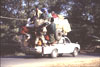 Infrastructure
within Myanmar is often much worse than visitors from foreign countries are used to. It is inferior even to Thailand’s
infrastructure. Therefore one needs to allocate considerably more
time and expect less comfort when traveling than at home. Most cars
are rather old, although we do take great care to choose cars in
good condition. Especially in the high season, you might encounter
shortages.
Infrastructure
within Myanmar is often much worse than visitors from foreign countries are used to. It is inferior even to Thailand’s
infrastructure. Therefore one needs to allocate considerably more
time and expect less comfort when traveling than at home. Most cars
are rather old, although we do take great care to choose cars in
good condition. Especially in the high season, you might encounter
shortages.
Flying reduces travel time considerably over land transport, so most
visitors choose that mode of transportation for longer distances.
Myanmar people are very friendly and helpful. There will always be
someone to help you. However language barriers might make it
difficult if you are traveling without a guide.
During the rainy season (June to September) there might be
disruptions to travel.
Top
Which is
the best time to visit Myanmar (Burma)?
Most people visit Myanmar during the “cool” and dry season from
November to February. In this time, night temperatures drop to 17
degrees Celsius in Yangon and just above 0 in the mountains.
Many people have a wrong perception of the rainy season (May to
September). Although in the coastal region, monsoon rainfalls are
very heavy, in the middle parts of the country they are not. It
rains in regular intervals, but uninterrupted and day-long rainfall
is rather unusual. Very often sun and rain change in short
intervals. The rainy season is certainly very pleasant to people who
enjoy the green nature and all plants growing. It is also possible
to visit Bagan and Mandalay during the rainy season as they lie in
the dry belt. High humidity in connection with very warm weather
however can be very challenging for some people.
The danger of Malaria is generally greater in the rainy season.
General matters:
Should I visit Myanmar at
all?
There are many pros and cons.
The overall economic situation and American sanctions (since 2003)
has brought hardship to ordinary people in Myanmar. Many people
support themselves and their families by income generated from
tourism. Be it directly through employment in hotels or as tour
guides, souvenir producers, sidecar (rickshaw) drivers, food stall
operators or fruit and cigarette vendors, local people work hard in
the tourist industry.
Myanmar people appreciate contacts to foreign visitors and the
outside world. Within the country, you will find only few local
people, who support a boycott.
At the end, everybody has to answer the question for her or himself.
As a visitor, you have the choice to spend your money where you
think it will most benefit the people.
After cyclone Nargis in May 2008, many people were asking themselves
that question again. To give people support and let them earn an
income is probably the much better way than giving hand-outs.
How is healthcare in
Myanmar?
Substandard health facilities probably pose the biggest risk when
traveling through Myanmar.
Outside of large cities medical facilities are not satisfactory, even
in Yangon hospitals rarely reach international standards.
Do bring with you sufficient supplies of
any medicine you may depend
on, and possibly a first-aid kit. Especially in larger towns, plenty
of medicine is available, however often there are warnings of fake
drugs.
What food do Myanmar people eat - Is it safe to eat anywhere?
Although there are great regional differences, food tends to be quite
oily or spicy. Myanmar people eat a lot of rice, fish, "Ngapi"
(fermented fish paste) and vegetables. The average meal will consist
of rice, a curry and some vegetables.
"Mohingha" (fish soup with rice noodles) is a favorite food and well
known amongst foreigners. It is eaten usually in the morning. Dried
fish is also very popular.
MSG (Monosodium Glutamate - locally known as Ajinomoto) is
frequently used in large quantities. When ordering, you may request
not to use MSG, but this is not always followed through.
The best way to avoid possible stomach problems is to look carefully
at the hygiene of restaurants. A dirty looking restaurant with few
customers is not a good sign. Usually foreigners are warned to not
eat at small food stalls, whereas one can see the worse hygienic
conditions. Be careful with raw food and fruits, especially those
you can’t peel.
Please avoid crushed ice, whereas ice cubes should be no problem. Do
not drink tap water but bottled water with intact seals only.
Should I take Malaria prophylaxis for a trip to Myanmar?
The first advice on this should always be: Avoid mosquito bites!!
Especially at dawn, wear long clothes and use mosquito repellents.
The answer on prophylaxis is a very difficult one depends on where
you go and at what time of the year. The side effects are sometimes very
strong and there is no guarantee that you will prevent getting Malaria with
a prophylaxis.
At the main tourist points Malaria is however rare, except on land
routes into the mountains and at the beaches.
Doctors with experience in tropical regions or Tropical institute
offer the best advice based on your itinerary.
Do I need
any insurance for travel to Myanmar?
Although there is no mandatory insurance required, we suggest the
following:
Health insurance with emergency evacuation (please be sure to check
with your insurance company that they do cover your trip to Myanmar).
Cancellation trip insurance.
Very few service providers in Myanmar have an adequate insurance to
cover guest’s claims; if any at all.
Top
Communication with Myanmar
Can I
access my e-mails and internet in Myanmar?
There are currently a number of Internet cafes in the main
tourist areas and larger towns. However a great number of e-mail
providers are blocked. You may use a local address provided by the
shop to send your emails.
Aside from e-mail providers, only very few web-pages are blocked.
Can I use my mobile
phone in Myanmar?
Mobile phones, if discovered in the past in your luggage,
had to be deposited with customs until your departure. In the last
few years, we however did not hear anymore of enforcing that practice.
How do I have to behave in Myanmar? What offends Myanmar people?
Myanmar is still a country with very conservative manners. Please act
and dress accordingly.
Wearing very short skirts or shorts is considered impolite especially
while visiting Pagodas.
Pointing out to something with your legs and patting someone on the
head is also regarded as a bad manner.
Sitting etc. on Buddha images e.g. for photographs is absolutely
unacceptable.
If you have any further questions, please don’t hesitate to contact us
with specific questions .
Top